
A hospital employee shuttle Maryland program starts with shift demand, safe pickup points, dependable schedules, and a qualified transportation operator. You should map staff arrivals, select vehicles, test routes, and measure performance before approving a recurring contract.
Hospitals cannot treat employee transportation like occasional group travel. Your emergency department, operating rooms, housekeeping, and laboratory teams work different hours. A successful hospital employee shuttle Maryland plan accounts for those differences without slowing clinical handovers or congesting ambulance entrances.
Hospital Employee Shuttle Maryland Planning Priorities
Reliable staff arrival is the first goal. Start by identifying the workforce groups that struggle with parking or transit connections. Your hospital employee shuttle Maryland strategy should also define which departments receive service and which trips qualify.
Hospital Staff Transportation Needs
Your planning team should classify 3 trip patterns: remote parking transfers, transit station pickups, and travel between medical buildings. Each pattern needs different operating hours, stop spacing, and vehicle capacity. Ask nursing leaders, facilities supervisors, and security staff to identify the highest-risk arrival windows.
Define the riders you will serve before choosing a bus. Employees include nurses, pharmacy technicians, medical assistants, maintenance staff, and food-service workers. Do not assume every employee starts at 7 a.m. Hospital departments frequently use overlapping schedules, on-call coverage, and weekend rotations.
Employee Attendance and Parking Goals
Set 3 measurable objectives: fewer late arrivals, fewer parking bottlenecks, and predictable employee pickup times. Record your current attendance figures and parking occupancy before launching new service. That baseline helps you judge a hospital employee shuttle Maryland program with evidence rather than impressions.
Assign ownership to human resources, facilities, and an operations lead. Human resources can manage workforce communication. Facilities can approve curb access. Your operations lead should coordinate dispatch, budget approval, and service reviews.
Hospital Employee Shuttle Maryland Demand Assessment
Build your schedule from actual employee demand. Collect staffing rosters, commute patterns, and current parking usage for 14 consecutive days. Your hospital employee shuttle Maryland survey should request preferred stops, shift times, and mobility needs without medical details.
Nursing Shifts and Department Schedules
Group employees by 3 sample shift changes: 7 a.m., 3 p.m., and 11 p.m. Treat those times as planning examples, not universal hospital hours. Confirm actual times with nursing, environmental services, laboratory management, and security before scheduling departures.
Measure the highest 15-minute arrival window, not the average daily headcount. A vehicle carrying 15 people cannot move 45 waiting employees in one departure. Add relief coverage for emergency call-ins, delayed handovers, and sudden schedule changes.
Staff Pickup Locations and Ridership Data
Map anonymized home-area clusters or preferred transit hubs instead of publishing personal addresses. Useful Maryland examples include Bethesda Metrorail, Baltimore Penn Station, and remote employee parking facilities. Record the number of riders expected at each approved stop.
Use a spreadsheet or route-planning system to group demand by location and time. Keep rider lists separate from patient records. Your hospital employee shuttle Maryland forecast should count seated capacity, accessibility requirements, and realistic route recovery time. Review AZA's Maryland coverage when your staff commute from across the state.
Maryland Hospital Shuttle Routes and Pickup Points
Start with the shortest reliable routes. Connect remote parking facilities, transit stations, and staff entrances without passing through emergency vehicle lanes. Choose stops with lighting, marked pedestrian access, and enough curb space for your selected vehicle.
Remote Parking Lot Connections
Plan direct transfers from approved satellite lots to one designated employee entrance. A 2-mile (3.2 km) route still needs a measured travel time during shift changes. Test the full loop with loading, unloading, traffic signals, and parking-lot circulation included.
Designate a waiting area clear of ambulance bays and patient drop-off zones. Coordinate stop signs, pavement markings, and accessible pedestrian routes with your property team. A hospital employee shuttle Maryland contract should identify every permitted stop before service begins.
Metro, MARC, and Hospital Campus Connections
Build last-mile connections around actual transit arrival patterns. Examples include Washington Metropolitan Area Transit Authority (WMATA) Metrorail and Maryland Area Regional Commuter (MARC) rail service. Confirm current timetables before publishing shuttle departures because weekend and late-night service differs by route.
Johns Hopkins lists campus shuttle routes and real-time tracking. The University of Maryland Medical Center publishes a Downtown-to-Midtown shuttle loop. Suburban Hospital identifies a hospital-to-Bethesda Metrorail connection among staff benefits. Those examples show why your hospital employee shuttle Maryland route should match local geography.
Employee Shuttle Scheduling for 24-Hour Hospitals
Match departures to the actual clock-in requirement. Schedule staff arrivals before reporting time, then include walking and security-screening time. Your hospital employee shuttle Maryland timetable must also cover evening departures and weekend staffing.
Morning, Evening, and Overnight Shift Coverage
Plan 3 service windows around approved rosters rather than running empty vehicles continuously. Offer predictable departures before shifts and after handovers. Separate overnight demand from daytime demand because transit availability, lighting, and dispatch coverage change after midnight.
A 24-hour hospital does not automatically need 24-hour shuttle circulation. Compare scheduled trips with on-demand dispatch during low-ridership hours. The better option depends on confirmed requests, employee wait limits, and staffing needs.
Travel Time and Schedule Recovery
Calculate cycle time as driving minutes plus dwell minutes plus a recovery allowance. For example, a 16-minute route with 4 minutes of boarding takes 20 minutes before recovery. Treat sample calculations as planning illustrations, not promised service times.
Test routes during actual shift windows and document recurring delays. Add extra recovery for heavy rain, snow, construction, and hospital entrance restrictions. Your hospital employee shuttle Maryland schedule should publish both departure times and escalation contacts for missed pickups.
Hospital Shuttle Vehicle Capacity and Accessibility
Select vehicles for peak demand, not typical demand. Count riders waiting at the busiest stop and confirm actual passenger capacity. Match boarding height, luggage space, and accessibility equipment to the approved route.
Vehicle Selection by Passenger Demand
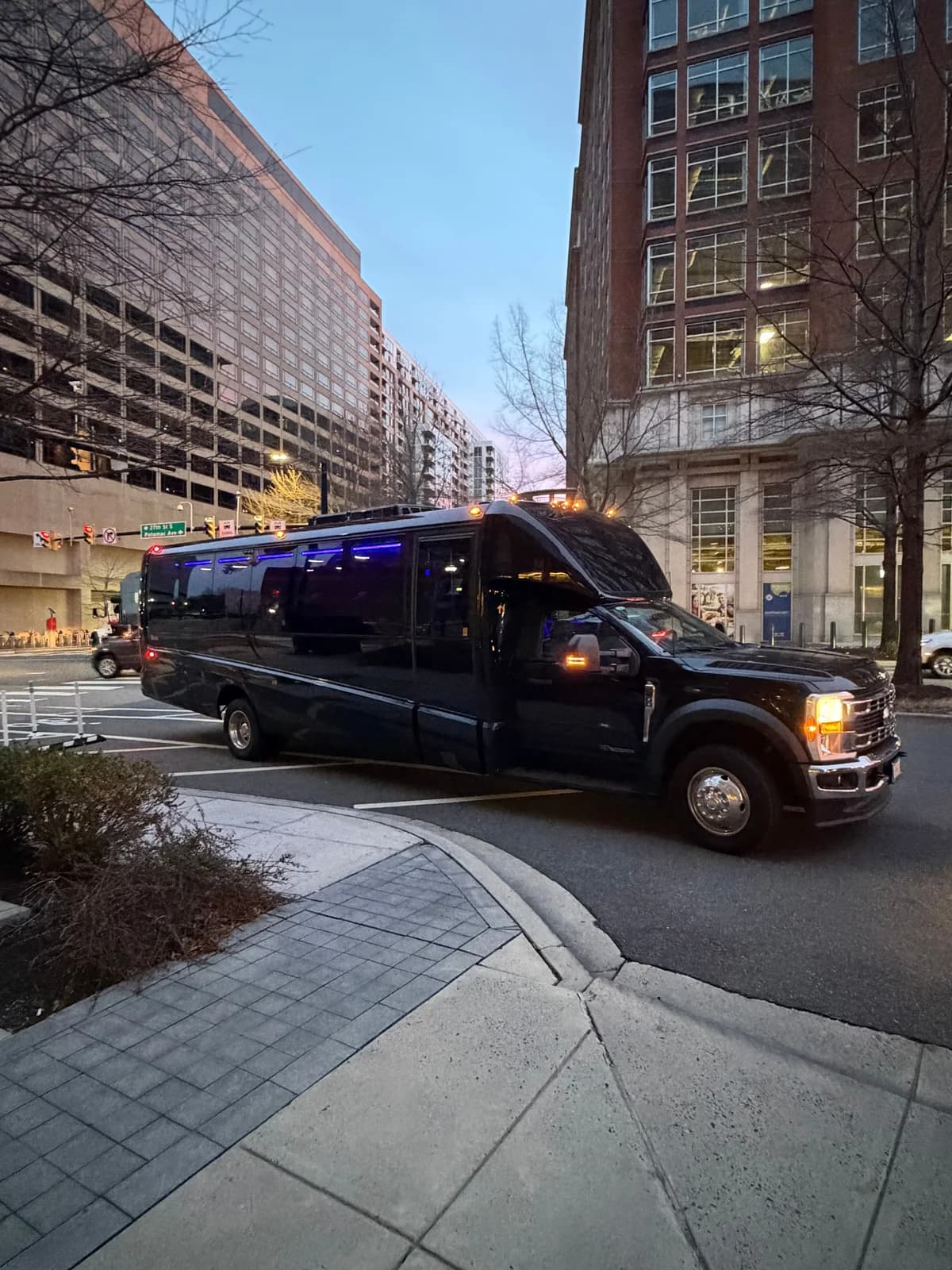
AZA lists a 15-passenger Mercedes Sprinter, 30-passenger Mini Party Bus, 40-passenger GM40 Black Bus, and 56-passenger VanHool Motorcoach. These published capacities provide starting points for a procurement discussion. Confirm each vehicle's available seating and route suitability before assigning service.
A hospital employee shuttle Maryland route serving 12 riders per trip needs different equipment from a 38-rider parking loop. Your hospital employee shuttle Maryland plan must not treat advertised seats as guaranteed space for every passenger mix. Confirm boarding arrangements for mobility devices and staff carrying approved equipment.
Accessible Boarding and Employee Safety
Ask your provider to document accessible vehicle availability, boarding procedures, and any applicable disability access requirements. Verify curb ramps, surface conditions, safe crossing points, and accessible entry paths with facilities staff. Do not assume every advertised vehicle includes a wheelchair lift.
Provide lighting at stops and a visible dispatch contact. Test walking routes during darkness, rain, and winter conditions. Hospital shuttle service also needs a defined response for a stranded rider or inaccessible stop.
Maryland Hospital Shuttle Service Pricing
Compare complete contracted service costs, not headline hourly rates. Your hospital employee shuttle Maryland budget must include route coverage, waiting time, vehicle minimums, and backup arrangements. Ask AZA for a written recurring service proposal tied to exact schedules via the corporate shuttle service page.
AZA Transportation Published Vehicle Rates
AZA's published rates page lists the Mercedes Sprinter at $150 per hour, with a 4-hour minimum. The Mini Party Bus and GM40 Black Bus each show $180 per hour, also with 4-hour minimums. The VanHool Motorcoach lists $220 per hour with a 5-hour minimum.
Those figures are published base rates, not fixed monthly hospital shuttle charges. AZA notes that mileage, parking, standard transportation charges, and other surcharges affect final quotes. The website also lists a $15 fee for trips starting between midnight and 5 a.m. Eastern Time.
Monthly Contracts and Cost-per-Ride Calculations
Request monthly pricing for named stops, vehicle hours, driver coverage, and service days. Ask for separate assumptions on fuel, deadhead travel, overtime, cancellation, and replacement vehicles. Do not convert charter base rates into an invented recurring contract price.
Measure cost per completed passenger ride by dividing the actual monthly invoice by recorded boardings. For example, 1,200 verified monthly rides form the denominator for your own invoice total. Compare route alternatives using identical staffing windows and accessibility requirements.
Discuss optional corporate shuttle coordination when your medical network includes outpatient buildings and administrative campuses. A hospital employee shuttle Maryland quote should distinguish employee-only service from any patient transportation request.
Shuttle Operator Safety and Contract Standards
Choose a provider with documented operational controls. Review the vehicle list, driver credentials, dispatch hours, and emergency procedures. Your hospital employee shuttle Maryland agreement should identify accountability for every missed trip and safety event.
Driver Qualifications and Insurance Documentation
Request proof of applicable driver licensing, commercial insurance, inspections, and maintenance procedures. Federal Motor Carrier Safety Administration (FMCSA) guidance explains that interstate passenger rules depend on operating characteristics. Ask the operator to identify the federal and Maryland requirements that apply to your precise service.
Review driver rest plans for overnight schedules and overlapping hospital shifts. Require a process for reporting fatigue, vehicle defects, and road incidents. Security teams should approve access credentials and pickup locations before the driver begins the route.
Backup Vehicles and Emergency Response
Specify dispatch phone coverage, replacement vehicle procedures, and a delay notification threshold. A backup plan should cover flat tires, road closures, severe weather, and staff surges. Test the communication chain with a scenario before employees depend on the route.
Keep staff shuttle access separate from emergency patient transport. A hospital employee shuttle Maryland program does not replace ambulances, clinical escorts, or non-emergency patient transportation. Tell the provider exactly which rider groups the contract covers.
How to Launch a 30-Day Hospital Shuttle Pilot
To launch a 30-day hospital shuttle pilot, approve the route, confirm the roster, and test dispatch before inviting riders. Use 30 days as a proposed evaluation period, not a guaranteed vendor implementation timeline.
Route Validation and Staff Communication
During days 1 through 7, conduct site walks, safety reviews, and timed test loops. Publish a one-page rider guide with stop names, departure times, eligibility, and dispatch contact information. Ask department managers to share the guide with every affected shift.
During days 8 through 14, run supervised trips with actual loading conditions. Record boarding times and missed connections. Adjust stops only after facilities and security approve the changes.
Pilot Monitoring and Schedule Adjustments
During days 15 through 30, run the approved timetable and collect daily counts. Review punctuality, complaints, occupancy, and cancellations with the operator. Your hospital employee shuttle Maryland pilot should include at least 1 documented review each week.
Use scheduled shuttle transportation planning to discuss fixed loops, standby vehicles, and changing demand. Record approved changes in one shared operating schedule so every department uses identical times.
Hospital Shuttle Performance Measurement
Track service results weekly. Use 6 metrics: on-time arrivals, completed trips, ridership, seat occupancy, incidents, and cost per ride. Your hospital employee shuttle Maryland scorecard should distinguish provider delays from staffing changes.
On-Time Arrivals and Vehicle Occupancy
Set an agreed punctuality threshold inside the contract. Record actual arrival timestamps through a global positioning system (GPS) feed or dispatch logs. Review repeated delays by route segment instead of relying on isolated rider comments.
Divide boarded riders by available seats to calculate occupancy for each departure. A 15-seat shuttle carrying 12 riders records 80% occupancy. Track peak loading separately because a daily average can hide overcrowded departures.
Employee Feedback and Operating Costs
Survey riders after the first 2 weeks and again after day 30. Ask about wait time, stop safety, ride comfort, and schedule reliability. Review requests from night-shift staff, mobility-impaired workers, and employees without nearby transit options.
Compare invoices against completed trips and staffing coverage. Your hospital employee shuttle Maryland review should identify underused departures before cutting needed access. Keep an exception process for employees whose shifts end after public transit service.
Maryland Hospital Shuttle Implementation Checklist
Use the following checklist to assign responsibilities before launch. Hospital facilities, human resources, security, and the shuttle operator need written ownership. The timing represents a sample 30-day pilot plan, not a guaranteed service commitment.
| Task | Timing | Method | Difficulty |
|---|---|---|---|
| Confirm staff demand | Days 1-3 | Shift roster and anonymous survey | Moderate |
| Approve shuttle stops | Days 3-7 | Site walk and safety review | Moderate |
| Verify driver and vehicle records | Days 5-9 | Document review with provider | Moderate |
| Test peak routes | Days 8-14 | Timed drives and boarding logs | High |
| Run pilot departures | Days 15-30 | Dispatch log and rider counts | High |
| Review service results | Day 30 | Six-metric scorecard | Moderate |
Start with a signed route plan and a single dispatch contact. Use named owners for attendance reporting, stop maintenance, and complaint response. A hospital employee shuttle Maryland service becomes easier to manage when every operational decision has a documented owner.
Frequently Asked Questions
Can Maryland hospitals operate employee shuttles overnight?
Yes. Hospitals can request overnight coverage that matches actual staff shifts. Confirm operator availability, pricing, and safe pickup access before committing.
Do hospital shuttles need wheelchair-accessible vehicles?
Accessibility requirements depend on the service and applicable law. Review your rider needs and the operator's vehicle specifications before launch.
Is a staff shuttle cheaper than additional hospital parking?
The answer depends on verified costs. Compare the full shuttle invoice with parking leases, staff subsidies, and recorded ridership.
Can a Maryland hospital connect staff to Metro or MARC?
Yes. You can plan routes to approved transit hubs. Check current station service, permitted stops, and employee shift times first.
How long should a hospital shuttle trial last?
A 30-day pilot offers a practical starting point. Review actual demand and adjust the evaluation period around shift coverage.
Building a Reliable Hospital Shuttle Program in Maryland
Begin with shift demand, safe stops, and a written service standard. Confirm your hospital employee shuttle Maryland schedule against real staff arrivals and budget limits. Request Maryland employee shuttle services from AZA Transportation. Call (571) 725-8544 or share your hospital locations, workforce counts, and shift timetable through the employee shuttle service page.
About the author:
Amar-Awan