
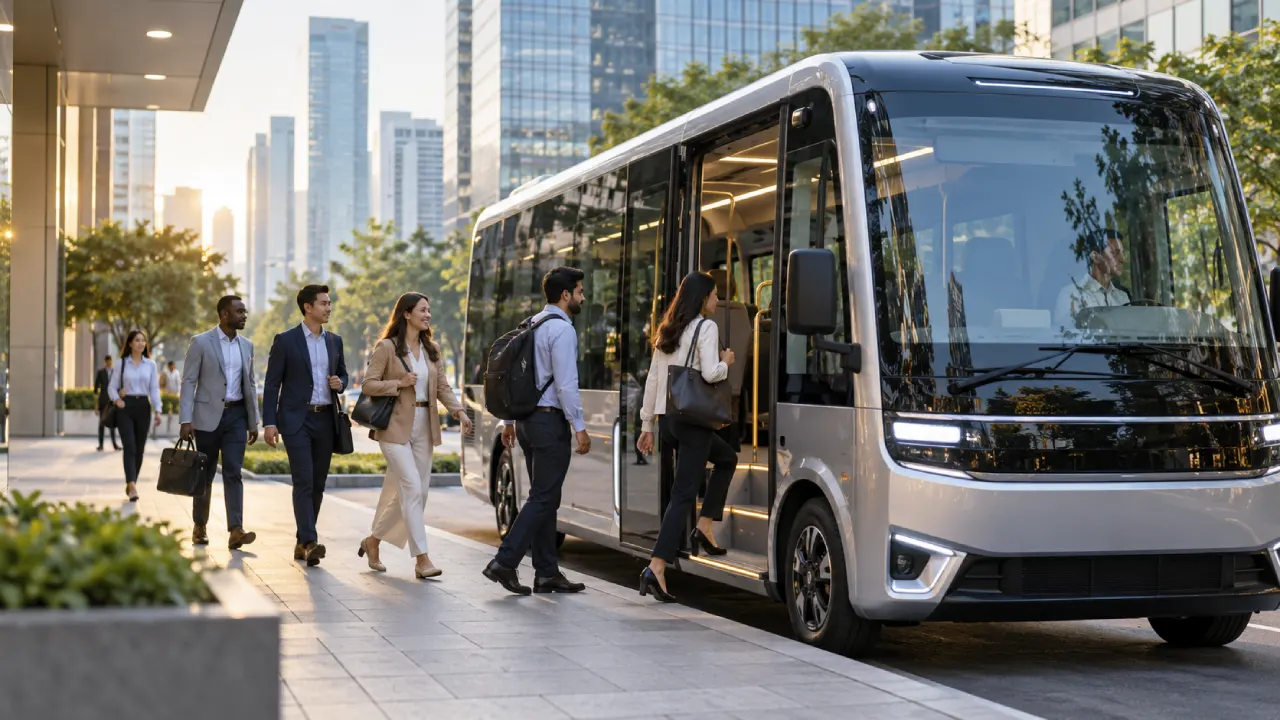
A staff shuttle service provides employees with dedicated transportation between agreed-upon pickup points and the workplace on a set schedule. A shuttle service for employees works through demand mapping, route design, vehicle assignment, scheduled pickups, dispatch, and performance tracking.
Employers use employee transportation programs to solve commuting barriers that public transit, parking, and individual driving do not solve well. A well-planned program connects homes, transit hubs, park-and-ride lots, offices, campuses, warehouses, hospitals, and industrial sites. The employer defines service goals, while the transportation provider manages daily movement.
For organizations in Washington, DC, Maryland, and Northern Virginia, an employee shuttle service DMV program can support daily workforce travel.
What Is a Shuttle Service for Employees?
A shuttle service for employees is a private transportation program that moves staff along routes aligned with workplace schedules. Employers can fund the full program, share costs, or structure another approved commuter arrangement.
The service normally connects 2 or more defined points. Common points include residential pickup zones, train stations, parking lots, offices, factories, and business parks. A provider assigns vans, minibuses, or motorcoaches based on expected ridership.
A shuttle service for employees differs from an occasional charter. The employee program repeats on defined days, times, and routes. Dispatch teams also track recurring performance, rider demand, and schedule changes.
What Makes a Staff Shuttle Different From Public Transit?
A staff shuttle serves a defined workforce, while public transit serves the general public on public routes. The employer shapes pickup points, operating hours, service frequency, and workplace arrival targets.
A commuter shuttle service can also cover early shifts, late shifts, weekends, and remote job sites. Public buses or rail services often follow broader network priorities. An employer route focuses on employee commute needs and business operating hours.
Which Employees Use Corporate Shuttle Programs?
Employees with shared destinations and predictable work schedules benefit most from company shuttle services. Common users include hospital teams, warehouse crews, office staff, hotel employees, government contractors, and manufacturing workers.
Large campuses also use shuttle routes to connect buildings, parking areas, and transit stops. A shuttle service for employees also supports new-hire onboarding. Distributed employers can connect 2 offices when teams travel between sites.
How Does a Shuttle Service for Employees Work?
A shuttle service for employees uses 5 stages: demand mapping, route design, vehicle assignment, scheduled service, and performance review. Each stage converts workforce data into a repeatable plan.
The employer first shares headcount, shift times, work locations, and broad home areas. The provider then clusters rider demand and tests practical pickup points. The provider assigns a vehicle after the route team estimates peak riders and trip duration.
Dispatch staff runs the daily schedule after launch. Managers review ridership, punctuality, missed trips, and route changes monthly.
How to Map Employee Pickup Demand
To map employee pickup demand, collect home ZIP codes, shift assignments, workdays, and preferred pickup areas. Protect personal addresses by using ZIP codes or approved geographic zones during early planning.
Group employees into geographic clusters, such as Arlington, Alexandria, Bethesda, or Reston. Test each cluster against shift start times and workplace arrival targets. A planning team can test a 0.5-mile (0.8-km) walking radius around proposed stops.
How to Build Routes Around Work Shifts
To build routes around work shifts, work backward from the required clock-in time. Add driving time, planned stop time, site entry time, unloading time, and a schedule buffer.
A 7:00 a.m. shift should not use a route that reaches the gate at 7:00 a.m. Set an earlier worksite arrival target. The exact buffer should reflect traffic patterns, security checks, walking distance, and locker time.
For rotating schedules, create separate route plans for named shifts, such as first, second, and overnight. Keep pickup instructions consistent across recurring days.
How to Choose the Right Vehicle Size
To choose the right vehicle size, match the highest expected rider count to real seat capacity. Add room for accessibility needs and approved carry-on items.
AZA Transportation lists 15-passenger Sprinter vans, 30-passenger GM33 buses, 40-passenger GM40 buses, and 56-passenger VanHool motorcoaches. Vehicle choice should follow actual route demand, not total company headcount.
A shuttle service for employees can use smaller vehicles on lower-demand routes and larger vehicles on peak routes. Right-sizing reduces empty seats without creating standing or denied-boarding problems.
Which Shuttle Service Models Fit Different Workplaces?
3 common service models cover most workforce needs: fixed-route commuting, last-mile connections, and inter-site or shift transportation. The right model depends on employee origins, transit access, site layout, and working hours.
Fixed-Route Commuter Shuttles
Fixed-route commuter shuttles work best when many employees travel from stable pickup zones to one workplace. The vehicle follows the same stops and timetable on scheduled workdays.
A fixed shuttle service for employees gives riders clear expectations. Fixed routes also simplify dispatch, employee communication, and monthly service analysis.
Last-Mile Transit Connectors
Last-mile connectors link a rail station, bus hub, or park-and-ride location with the workplace. The model works well near strong public transportation networks.
Employers should align shuttle departures with named transit arrivals. Dispatch teams should monitor common delay patterns and protect transfer time. The route can serve multiple scheduled loops during morning and evening peaks.
Inter-Site and Shift Shuttles
Inter-site and shift shuttles move employees between facilities or cover work hours that public transit serves poorly. Common examples include hospital campuses, warehouse complexes, office parks, and manufacturing plants.
A corporate shuttle service DMV plan can combine recurring staff routes with business travel needs. A single contract can define separate schedules for employee commuting and corporate movement.
What Does a Shuttle Service for Employees Cost?
A shuttle service for employees costs more or less depending on vehicle size, service hours, mileage, number of routes, and frequency. Contract length also changes pricing. Tolls, parking, waiting, special equipment, and after-hours changes may incur additional charges.
AZA Transportation publishes hourly fleet rates with minimum booking periods for selected vehicles. Recurring employee service needs a custom route quote.
You should compare cost per rider, not only vehicle price. A lower hourly rate can result in a higher total cost when a poor route requires extra vehicles or incurs excessive deadhead mileage.
Which Pricing Factors Change Monthly Cost?
6 pricing factors usually drive monthly cost: vehicles, hours, mileage, routes, service days, and special operating requirements. Each factor changes the provider’s staffing and fleet plan.
Peak demand may require 2 vehicles, whereas off-peak demand requires 1. Multiple shifts also extend service hours. Stable ridership improves budgeting.
Which Contract Items Need Separate Pricing?
Contracts should state charges for tolls, parking, overtime, waiting time, cleaning, route changes, and special vehicle requests. Clear pricing rules protect both the employer and provider.
Ask for cancellation terms, holiday service rules, billing frequency, and change-request procedures. Also ask how the provider prices backup vehicles after a mechanical issue or an unexpected increase in demand.
How to Launch a Shuttle Service for Employees in 6 Steps
To launch a shuttle service for employees in 6 steps, define demand, design routes, and vet providers. Then run a pilot, communicate schedules, and review performance. A 6-week planning target gives a single-site pilot a practical structure without forcing rushed decisions.
How to Survey Employee Commute Needs
To survey employee commute needs, ask for ZIP code, shift, workdays, current travel mode, preferred stop area, and accessibility needs. Keep the survey short enough to ensure high completion rates.
Use the survey to estimate real ridership. Segment responses by shift and location. A shuttle service for employees performs better with demand-based routes.
How to Pilot One Route
To pilot one route, choose the strongest demand cluster and run a defined test before a broad rollout. Use 5 working days for a first operational test when schedules permit.
Track scheduled arrival, actual arrival, boardings, missed riders, delays, and rider comments. Keep stop names and pickup instructions identical during the test. Change measured problems after the pilot.
How to Track Route Performance
To track route performance, record on-time arrivals, completed trips, ridership, seat use, complaints, and cost per rider. Review results at least monthly for stable recurring service.
Use one owner for route decisions, such as a facilities manager, human resources manager, or workplace operations lead. One decision owner reduces conflicting change requests.
| Task | Suggested Timing | Method | Difficulty |
|---|---|---|---|
| Demand survey | 3 business days | Collect ZIP codes, shifts, and rider interest | Easy |
| Route design | 4 business days | Cluster origins and test stop timing | Moderate |
| Provider review | 5 business days | Check fleet, insurance, safety, and backup plan | Moderate |
| Pilot route | 5 working days | Run 1 route and measure performance | Moderate |
| Launch communication | 2 business days | Publish stops, times, rules, and support contact | Easy |
| Performance review | Every 30 days | Review punctuality, ridership, and cost | Moderate |
What Safety and Accessibility Checks Should Employers Make?
Employers should verify carrier authority, insurance, driver qualifications, vehicle readiness, accessibility planning, and emergency procedures before launch. Safety review should cover both paperwork and daily operations.
The Federal Motor Carrier Safety Administration (FMCSA) provides registration and safety information for interstate passenger carriers. FMCSA advises planners to check registration and insurance status.
The Americans with Disabilities Act (ADA) creates accessibility duties across employment and transportation contexts. Employers should review applicable obligations with qualified legal or compliance advisers for each program.
How to Verify Carrier Registration and Insurance
To verify carrier registration and insurance, search the provider through applicable federal and state transportation records. Request current insurance documents and confirm coverage before service begins.
For interstate compensated passenger service, use FMCSA resources to review operating status and available safety information. Keep verification records with contract and renewal dates.
How to Plan Accessible Employee Transportation
To plan accessible employee transportation, identify rider accommodation needs before final vehicle assignment. Ask the provider about wheelchair access, boarding assistance, securement equipment, and accessible pickup locations.
Keep the request process private and clear. Train dispatch contacts on accommodation procedures. A shuttle service for employees should provide approved riders with a usable route from pickup to their workplace.
How to Prepare for Breakdowns and Delays
To prepare for breakdowns and delays, define backup vehicles, replacement drivers, emergency contacts, and rider communication rules in writing. Test the communication chain before launch.
Set a response owner for each service window. Use text alerts, email updates, or a rider application for delay notices. Record each service failure and review the cause.
What Benefits Can Employers and Employees Expect?
A well-run shuttle service for employees can improve commute reliability, reduce parking demand, and expand hiring access. Route quality and rider adoption drive results.
Shared employee transportation reduces separate vehicles arriving at one site. Employers can measure impact with parking, attendance, and commute data.
How Shuttle Programs Support Attendance
Scheduled staff transportation provides employees with a reliable arrival option tied to shift times. The program reduces dependence on individual cars, informal carpools, and limited off-hours transit.
A shuttle service for employees works especially well for fixed shift changes. Managers should compare late arrivals before and after launch while controlling for schedule changes.
How Shuttle Programs Reduce Parking Pressure
Higher shuttle ridership reduces employee demand for individual parking spaces. The employer can track parking occupancy before launch and after 30, 60, and 90 days.
Parking relief can support offices, hospitals, campuses, and industrial sites with limited space. Employers can also use remote parking lots with a short workplace connector.
How Shuttle Programs Support Recruitment and Retention
Reliable commuting access expands the practical hiring area for employees without convenient workplace transportation. The benefit also removes a recurring travel barrier for current staff.
Recruiters can explain route coverage, pickup locations, and shift availability during hiring. Human resources teams should promise only confirmed stops.
How Should You Measure Shuttle Performance?
Measure a shuttle service for employees with punctuality, trip completion, ridership, seat use, cost per rider, complaints, and satisfaction. Each metric answers a different operating question.
Set baseline values before launch. Track parking occupancy, late arrivals, absenteeism, and commute satisfaction. Review route results monthly.
On-Time Performance and Missed Trips
On-time performance shows whether shuttles meet the published arrival target. Track every scheduled trip and record the cause of each late or missed trip.
Separate provider-caused delays from external disruptions, such as crashes, road closures, or severe weather. Use route-level reporting instead of one combined monthly percentage.
Ridership and Seat Use
Ridership shows adoption, while seat use shows capacity efficiency. Count boardings by route, stop, shift, and day.
A shuttle service for employees with repeated low seat use needs route review. The team can adjust stop patterns, frequency, or vehicle size if changes in demand persist.
Cost Per Rider and Employee Feedback
Cost per rider connects transportation spending with actual usage. Divide route cost by completed rider trips for the same reporting period.
Pair financial data with short employee surveys. Ask about punctuality, stop convenience, communication, comfort, and reliability. Use the same questions each quarter to compare trends.
Is a Shuttle Service for Employees Right for Your Workplace?
A shuttle service for employees fits workplaces with recurring commute barriers, shared destinations, predictable schedules, or parking constraints. Strong candidates include campuses, hospitals, warehouses, factories, offices, and business parks.
You should test 4 questions before requesting proposals. Do employees share common origin clusters? Do shifts create transit gaps? Does parking constrain operations? Can the employer support recurring service costs?
A “yes” answer to 2 or more questions supports a route feasibility review. A demand survey can then confirm whether enough employees will use the proposed service.
What Do Employers Ask About a Shuttle Service for Employees?
Is a Staff Shuttle the Same as Public Transit?
No. A staff shuttle serves an employer-defined rider group, schedule, and route. Public transit serves the general public on public network schedules.
Can You Run Employee Shuttles for Night Shifts?
Yes. A shuttle service for employees can cover overnight, early-morning, weekend, and rotating shifts with matching provider coverage.
Do You Need One Route for Every Employee?
No. Most programs cluster employees around shared pickup points. Route design should balance rider convenience, trip time, vehicle capacity, and operating cost.
Should You Track Ridership After Launch?
Yes. Track boardings by route, stop, shift, and day. Monthly ridership reports show where you should change frequency or vehicle size.
How Many Employees Fit Common Shuttle Vehicles?
Vehicle capacity depends on the assigned fleet. AZA lists 15-passenger Sprinter vans, 30-passenger GM33 buses, 40-passenger GM40 buses, and 56-passenger motorcoaches.
How Can You Start an Employee Shuttle Program in 2026?
Start with employee demand data, shift schedules, workplace locations, and a clear service goal. Then request route options, vehicle recommendations, pricing terms, safety documents, and a pilot plan. A shuttle service for employees works best as an operating program, not a one-time booking. For Washington, DC, Maryland, and Northern Virginia, contact AZA through shuttle transportation service DMV. Request a route-specific quote for your workforce.
About the author:
Tahir Mughal