You handle corporate event shuttle planning by mapping passenger demand, calculating vehicle capacity, confirming access, and assigning dispatch responsibility. Book against your arrival deadline, then publish clear boarding instructions and approve a backup plan before service starts.
Your corporate event transportation plan should connect your hotel, conference venue, airport, and evening reception. You need a passenger count for each journey, rather than 1 attendance total. A 180-person conference does not automatically require transportation for 180 people after dinner.
Use corporate event shuttle planning to document who travels, when each group leaves, and who approves changes. Your transportation provider then checks availability, vehicle suitability, and operating requirements against your actual itinerary.
Corporate Event Shuttle Planning Scope and Passenger Demand
Start with a trip register that includes your airport pickup, morning hotel transfer, dinner departure, and final return. Give each movement a route code, passenger estimate, boarding location, departure time, and arrival deadline.
Your corporate event shuttle planning register should distinguish between confirmed and tentative riders. Use your corporate shuttle planning checklist to track registration changes. Ask each attendee to select a departure during registration. Count your event staff separately when staff duties require earlier arrival or later departure.
Passenger Counts by Individual Trip
You need 1 passenger count per departure because attendance changes throughout your event. For example, record 120 morning riders, 90 dinner riders, and 65 late-return riders as separate demand estimates.
Collect only operational details, including your attendee's name, selected trip, mobile number, luggage count, and boarding assistance request. Keep dietary information out of your transport manifest unless a specific transport arrangement requires it.
Arrival Deadlines and Service Ownership
You should appoint 1 event transport lead and 1 backup before requesting quotations. Your lead approves schedule changes, while your provider's dispatcher directs vehicle movements.
Set your arrival deadline before your registration or presentation start. For a 9:00 AM session, choose an 8:40 AM venue arrival time. Your 20-minute allowance covers your walk, badge collection, and room entry; validate it with venue staff.
Corporate Event Shuttle Planning Capacity and Departure Math
Calculate completed outbound trips before your deadline, rather than multiplying seats by an assumed trip count. Your first departure, turnaround, and final arrival determine your usable capacity.
Your corporate event shuttle planning calculation needs 4 inputs: rider demand, usable seats, outbound travel time, and repeat departure interval. Your shuttle fleet capacity planning must use your actual departure window. Your repeat interval includes outbound travel, unloading, return travel, and boarding before the next departure.
Complete Cycle Time and Fleet Size
You can test capacity with an illustrative 120-rider transfer using 40-seat buses. Assume 15 minutes outbound, 5 minutes unloading, 15 minutes returning, and 5 minutes boarding.
Your repeat departure interval equals 40 minutes. After initial boarding, your first bus departs at 8:00 AM and arrives at your venue at 8:15 AM. Your second departure is at 8:40 AM, arriving at your venue at 8:55 AM.
For an 8:40 AM arrival deadline, count 1 qualifying trip per bus. Divide 120 riders by 40 seats and 1 qualifying trip; you need 3 buses under these assumptions.
Your corporate event shuttle planning model must round vehicle requirements upward. Confirm actual traffic, luggage storage, boarding assistance, and vehicle availability before treating your calculation as a booking plan.
Vehicle Capacity and Luggage Limits
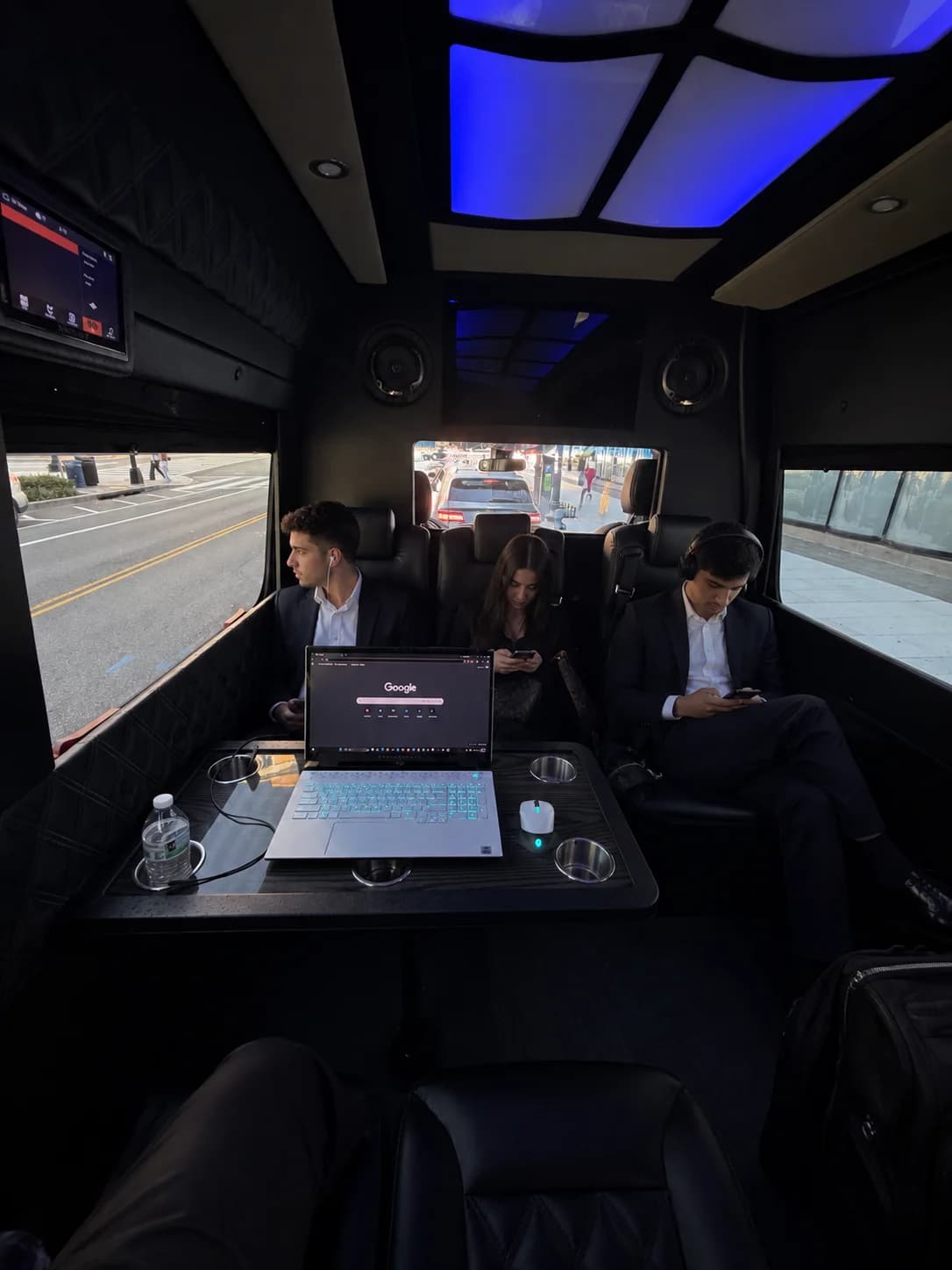
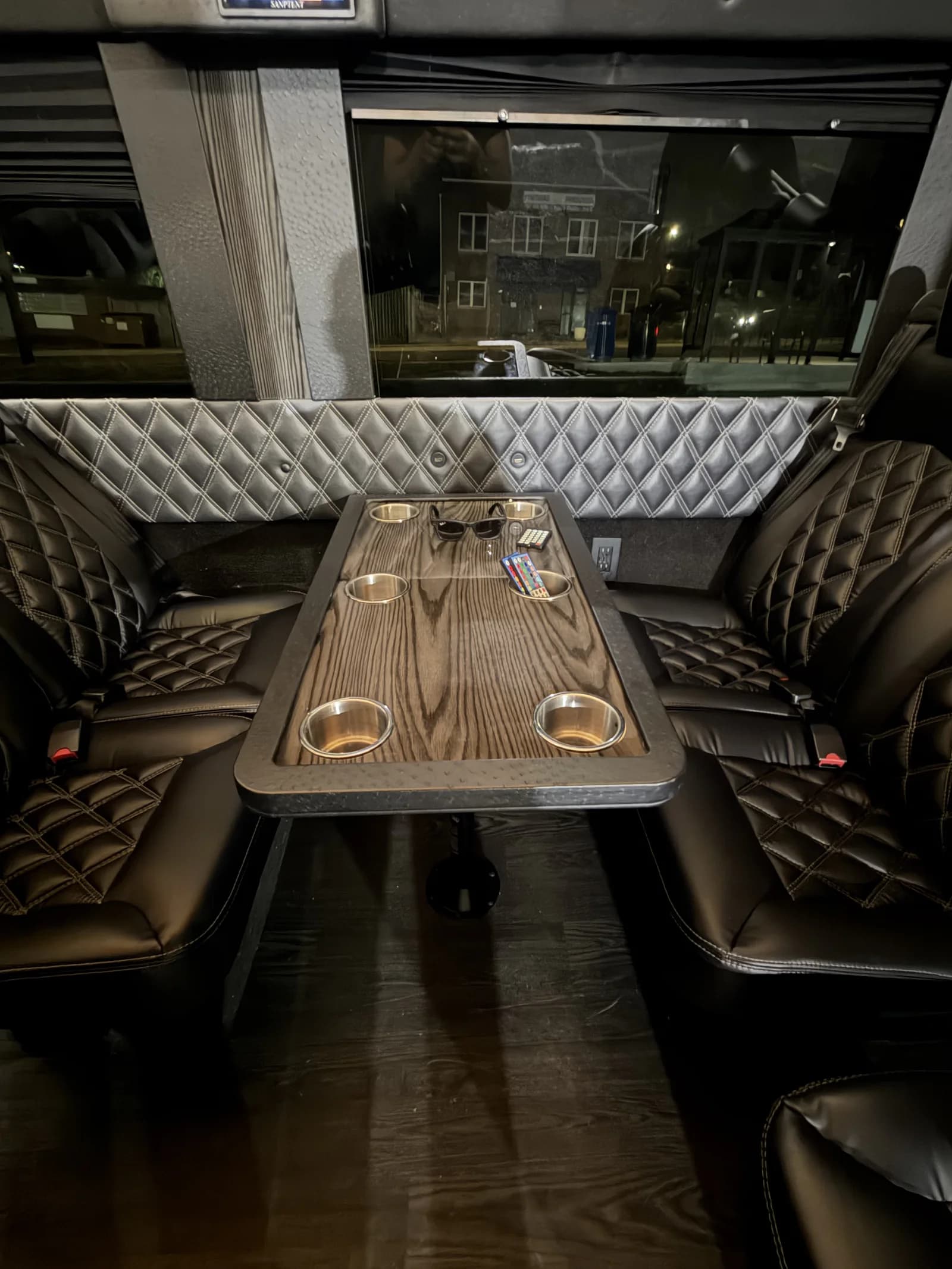
Check seats and suitcase storage separately when choosing your corporate shuttle service. AZA lists its GM40 Black Bus for up to 40 passengers and 28 suitcases.
You therefore need additional storage planning for 40 passengers at the airport carrying 40 large suitcases. Compare your charter bus service choices against your actual luggage count before selecting a vehicle.
Your corporate event shuttle planning brief should request the confirmed seating layout for the assigned vehicle. Ask about wheelchair positions, boarding equipment, charging access, and climate control, without assuming every vehicle has the same equipment.
Shuttle Service Models for Hotels and Conference Venues
Choose 1 of 3 service models: scheduled departures, continuous loops, or a combined schedule. Match your conference shuttle service to your attendees' arrival patterns and the venue's timetable.
Choose scheduled departures for your fixed hotel group, such as an 8:00 AM conference transfer. Publish boarding and departure separately so your passengers understand when boarding closes.
Choose continuous loops for your staggered parking arrivals, such as employees arriving throughout a 60-minute reception window. State a departure frequency only after your provider confirms sufficient vehicles and repeat cycle times.
Choose a combined schedule for your conference hotel transfer and evening reception loop. Keep your speaker pickup separate when your speaker's presentation requires a different arrival deadline.
Your corporate event shuttle planning schedule should also identify your last return. Publish your final boarding time before registration opens, especially when your reception includes alcohol service.
Compare AZA's event shuttle transportation service with your hotel loop and convention transfer requirements. Send your proposed timetable so AZA can assess your service pattern.
DMV Route Checks and Venue Loading Arrangements
Validate your route with your operator and venue, including your loading entrance and passenger walking route. Your event shuttle route planning must account for your assigned vehicle. Plan locally across Washington, DC, Maryland, and Virginia (DMV), rather than assuming downtown travel is the same as suburban travel.
For your Tysons hotel and Washington conference venue, test your route at the planned departure time. Ask your operator to check road restrictions, construction activity, staging access, and alternate routing.
Your corporate event shuttle planning map should mark your vehicle approach, boarding location, unloading location, and nearby indoor waiting area. Record walking distance in both units, such as an illustrative 500 feet (152 meters).
Airport Transfer Coordination
Group your passengers by airport and arrival window, then confirm your meeting location with your provider. Your corporate airport transfers need separate arrival sheets for Ronald Reagan Washington National Airport and Washington Dulles International Airport.
Record each flight number, scheduled landing, terminal, baggage requirement, and passenger contact. Your pickup time must account for your passenger's actual exit from baggage claim.
Your corporate event shuttle planning brief should specify your maximum shared-transfer wait time. Agree a specific wait limit with your provider, then assign later arrivals to a confirmed alternative departure.
Boarding Access and Venue Entrances
Confirm your complete boarding journey, including your curb access, vehicle entry, and venue entrance. Ask your attendee about any functional assistance they need, such as step-free boarding or wheelchair securement.
Obtain your provider's written confirmation before advertising accessible transportation. Verify the assigned vehicle, boarding location, assistance procedure, and available seating after wheelchair accommodation.
Ask your venue to approve a boarding area away from reversing traffic. Keep your queue clear of fire access, building exits, and public crossings. Check your passenger route after dark, when your final shuttle leaves in the evening.
Corporate Shuttle Budgets and Written Quote Comparisons
Compare your complete event cost, including vehicle time, mileage, parking, and applicable transportation charges. Your lowest hourly rate does not determine your lowest final invoice amount.
Your corporate event shuttle planning budget should use matching trip details for every quotation. Send identical dates, service windows, addresses, passenger counts, luggage requirements, and accessibility requests to each shortlisted provider.
Published AZA Base Rates
You can use AZA's published base rates as your initial reference. AZA lists the GM40 Black Bus at $180 per hour with a 4-hour minimum.
AZA lists the VanHool Motorcoach at $220 per hour with a 5-hour minimum. Your corresponding minimum base calculations equal $720 and $1,100 per vehicle before applicable additional charges.
Treat your corporate event shuttle planning figures as base calculations, not final event quotations. AZA identifies mileage, standard transportation charges, parking, and other surcharges as potential additions. Confirm applicable tolls and your final total directly with AZA.
Total Cost and Contract Terms
You should request 1 itemized written quotation covering your exact vehicle and service period. Ask your provider to explain waiting time, additional stops, overtime, and empty travel between the depot and pickup.
Confirm your deposit, cancellation deadline, rescheduling terms, and replacement vehicle procedure in writing. Record who can approve chargeable extensions and how your provider documents authorization.
Your corporate event shuttle planning budget also needs a controlled contingency amount. Set your allowance after reviewing the quoted cost of 1 extra trip or 1 additional service hour.
Passenger Instructions and Dispatcher Communication
Send 1 approved instruction message per route, including your boarding point, reporting time, departure time, and contact. Your hotel shuttle schedule needs the same approved departure information. Separate your attendee message from your driver's operational briefing.
Use a named boarding location such as "Hotel A conference entrance," then attach your verified map pin. Label your vehicle with your route code and destination; avoid publishing passenger names on exterior signage.
For corporate event shuttle planning, use communication tools such as Microsoft Teams, email, and text messaging for defined purposes. Keep your operational discussion inside Teams and send your attendee departure reminder through email or text.
Write your reminder clearly: "You board Route A at Hotel A’s conference entrance from 7:50 AM. Your shuttle departs at 8:00 AM Eastern Time." Add your coordinator’s confirmed mobile number before sending.
Your corporate event shuttle planning file should carry a version number, owner, and revision timestamp. Remove editing access from superseded copies and distribute your updated departure sheet to your dispatcher and boarding coordinator.
Delay Thresholds and Backup Transportation Decisions
Approve your response triggers before departure, then let your event lead authorize schedule changes. Use scenario assumptions that match your itinerary instead of treating sample thresholds as universal standards.
For an illustrative conference transfer, set a 10-minute predicted delay as your dispatch review trigger. Your dispatcher checks your alternate route, remaining seats, and standby availability before your lead approves a response.
Your corporate event shuttle planning backup should distinguish 3 disruptions: vehicle breakdown, road closure, and passenger overflow. Agree who supplies replacement transport, how quickly dispatch responds, and who authorizes additional spending.
Give your provider a separate deadline for confirming an accessible replacement. Keep your attendee informed through your coordinator while your provider verifies a suitable vehicle.
Report only confirmed arrival information. Send your next update time when your dispatcher cannot confirm an arrival estimate. Use corporate event shuttle planning to protect your attendee communication from unsupported promises.
Corporate Shuttle Planning Timeline and Task Table
Begin your draft 8 weeks before your event as a working planning target. Start earlier when your provider identifies limited availability for your selected date or vehicle.
Use the corporate event shuttle planning table to assign your owner and completion deadline. Treat the difficulty ratings as planning judgments for a typical event, rather than provider service guarantees.
| Task | Timing | Method | Difficulty |
|---|---|---|---|
| Map passenger demand | 8 weeks before | Registration trip selections | Moderate |
| Test fleet capacity | 6 weeks before | Departure and arrival calculation | High |
| Approve venue access | 4 weeks before | Operator and venue walkthrough | High |
| Confirm written quote | 4 weeks before | Matched itinerary comparison | Moderate |
| Finalize boarding roster | 7 days before | Route-specific manifest review | Moderate |
| Send passenger instructions | 48 hours before | Email and text reminder | Low |
| Reconfirm dispatch readiness | 24 hours before | Named coordinator briefing | Moderate |
| Reconcile completed service | 48 hours after | Trip log and invoice check | Moderate |
Schedule a final review with your dispatcher and venue contact. Confirm your driver assignment, first staging time, current passenger total, loading entrance, and last return departure.
Your corporate event shuttle planning review should also test 1 sample journey from your passenger's perspective. Open your directions on a phone and follow your route from the waiting area to the venue entrance.
Event Day Boarding and Postevent Performance Review
Record actual boarding, departure, and arrival times so your transport lead can compare delivery against your approved schedule. Your boarding coordinator manages attendee check-in while your driver concentrates on vehicle operation.
Use your route-specific manifest to mark each passenger's boarding status. Call your missing passenger once, then follow your approved departure policy. Record your decision without delaying another group's confirmed arrival deadline.
Your corporate event shuttle planning log should capture your vehicle number, completed trip, passenger count, and authorized schedule change. Add your dispatcher's confirmed explanation when traffic or vehicle issues affect service.
Review 3 performance measures after your event: on-time arrival percentage, longest observed wait, and cost per passenger journey. Divide on-time trips by completed trips, then multiply by 100 to calculate your arrival percentage.
Count a passenger's outbound and return rides as 2 passenger journeys. Divide your final transport invoice by completed passenger journeys for your cost measure.
Use your corporate event shuttle planning review to change specific decisions before your next booking. Increase boarding time after a measured loading delay, or adjust capacity after documented overflow.
Corporate Shuttle Planning FAQs
How far in advance should I book my corporate shuttle?
Use 8 weeks as your initial planning target. After you share your date and vehicle requirements with AZA, confirm your booking deadline with them directly.
How do I calculate how many shuttles I need?
Divide your total riders by the number of usable seats and qualifying trips, then round up. Only count departures that reach your venue before your arrival deadline.
Can I combine airport and hotel assignments on shared vehicles?
Yes, you can request shared vehicle scheduling. Before combining assignments, confirm your luggage capacity, airport timing, and vehicle repositioning.
How do I confirm the availability of accessible shuttles?
Request written confirmation for your exact trip. Your provider must confirm your assigned vehicle and boarding arrangement before you publish any accessibility details.
Is the published base rate my final shuttle cost?
Not necessarily. Request an itemized event quotation. Your published base rate excludes potential additional charges, and your final total is determined by your itinerary.
Your Corporate Event Shuttle Booking Plan
You complete corporate event shuttle planning with verified demand, workable departure times, approved loading access, and named decision owners. Send your itinerary, passenger counts, luggage details, and arrival deadline through AZA's corporate shuttle service page, or call (571) 725-8544. Request your written event quotation and confirm your vehicle availability before publishing your final shuttle schedule.
About the author:
Amar-Awan